



















ADVENDURE is the leading web portal in Greece about Mountain Running, Adventure, Endurance and other Mountain Sports
info@advendure.com



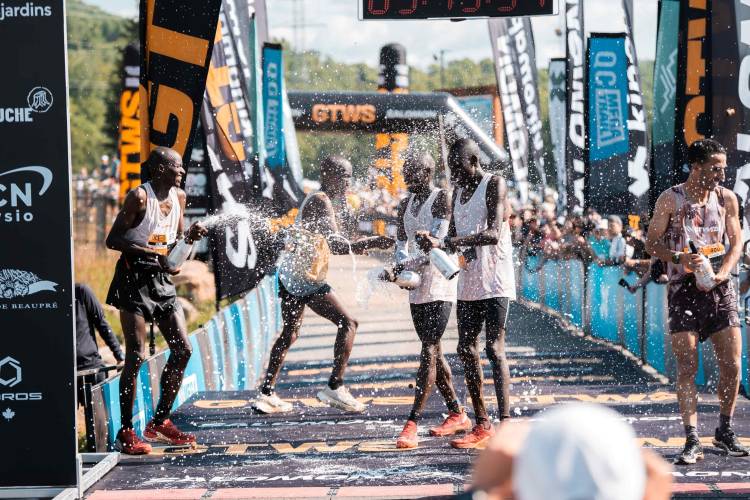 Quebec Mega Trail 2026 - Photo copyright: GTWS / Koastal Forest
For decades, whenever the word "Kenya" was mentioned in connection with running, the conversation revolved almost exclusively around road racing and track & field. Marathons, half marathons, world records, and athletes who seemed to operate on an entirely different—elite—level.
The mountains were a different world altogether, with their own rich history, unique culture, and iconic champions. Italians, Spaniards, Swiss, French, British, and American runners dominated for many years, enjoying the advantage of having grown up in the mountains, mastering every aspect of climbing, descending, and navigating technical trails.

In recent years, however, something has begun to change, and we are witnessing it clearly in mountain running races up to the marathon distance, as well as in major championships such as the WMRA Mountain Running World Cup and the Golden Trail World Series. Kenya is no longer competing only on the roads and the track—it is now racing on the trails, and it is winning.
To suggest that this is merely a coincidence demonstrates a lack of understanding of how these physiologically gifted African athletes operate. The remarkable rise of Kenyan mountain runners over the past few years is anything but accidental. For decades, the country has possessed a unique athletic infrastructure. Thousands of runners grow up and train at high altitude, developing characteristics that perfectly match the demands of modern mountain running:

Richard Omaya Atuya (Kenya) wins the Grossglockner Mountain Run – Photo copyright: WMRA / Jonathan Wyatt
The region of Iten, in the Kenyan Highlands, has evolved into one of the world’s most important endurance training hubs. For decades, it has been a reference point for elite runners and the “factory” that has produced many world-class marathoners. However, in recent years its role has expanded: more and more top runners from Europe and around the world are choosing Iten for training periods, recognizing that the altitude, the environment, and the training culture (The group environment is exceptional. Athletes train together every day, push each other constantly, and that collective mentality probably plays as big a role as physiology itself) create a unique setting for high-intensity racing.
The same physiological adaptations that produce world-class marathoners are now proving highly valuable in mountain running as well. High aerobic capacity, exceptional running economy, and the ability to sustain high speeds for long periods of time represent significant advantages in modern mountain running.
However, the success of Kenyan athletes cannot be explained by physiology alone. In recent years, they have made remarkable progress in the technical aspects of the sport as well. Athletes such as Patrick Kipngeno, Philemon Kiriago, and Joyce Muthoni Njeru are no longer winning simply because they possess greater endurance or superior aerobic capacity. They have evolved into complete mountain runners, with excellent technical skills, improved downhill management, and the ability to adapt to demanding terrain. Their progression on descents in particular — traditionally considered a strength of European athletes — has significantly changed the balance of power.
If there is one athlete who symbolizes this new era more than anyone else, it is Patrick Kipngeno. Kenyan athletes had already made their presence felt in mountain running competitions (WMRA races as an example) before him, but Kipngeno was the one who transformed that presence into a global statement. His dominance in vertical races, his performances in the Golden Trail World Series, and his victories against some of Europe's finest mountain runners changed the perception of what Kenyan athletes could achieve in the mountains, proving that they could become consistent contenders for victory at the highest level.

Patrick Kipngeno wins the 2026 Broken Arrow Skyrace Ascent in the USA – Photo copyright: iRunFar
Alongside him emerged a new generation: Philemon Kiriago, Joyce Muthoni Njeru, Ruth Mwihaki Gitonga, Ephantus Mwangi Njeri, and several other outstanding athletes. More importantly, these runners no longer view mountain running as a second choice, but as a discipline where they can build their own legacy—and earn significant money.
The Golden Trail World Series and the WMRA World Cup are perhaps the most representative examples of this transformation. In recent years, they have evolved into two of the most important global stages for high-intensity mountain races, from fast mountain running events to the marathon distance. Races such as Zegama-Aizkorri, Sierre-Zinal, and the Mont-Blanc Marathon now attract the world’s elite athletes.
The Golden Trail World Series, in particular, did not simply create a series of top-level races. It contributed to the creation of a true professional ecosystem around mountain running, with international exposure, increased sponsor interest, strong media presence, and meaningful prize money. This has gradually changed the dynamics of the sport, making it a more attractive professional career option for high-level athletes from East Africa and beyond.

Philemon Kiriago wins the 2025 Sierre-Zinal – Photo copyright: rising.story / mathisdecroux_SierreZinal
If the Golden Trail World Series represents the new, more commercial dimension of mountain running, the WMRA Mountain Running World Cup highlights the sport's competitive evolution through its longest-standing international competition series. At the same time, the WMRA, together with World Athletics and its partners in the organization of the World Championships, is part of the official working group examining the potential inclusion of mountain running in the Olympic Games.
Patrick Kipngeno and Philemon Kiriago consistently battle at the very front of the competition alongside athletes such as the outstanding Moroccan Elhousine Elazzaoui, creating a new global balance in which Africa now plays a decisive role.
The format of these races suits Kenyan athletes particularly well. They are relatively short, extremely fast, feature substantial elevation gain, and demand a unique combination of speed and endurance. These are qualities that African runners understand and manage exceptionally well.
Among the women, we have not yet witnessed the "Kenyan phenomenon" to the same extent. At least not yet. Joyce Muthoni Njeru has already become one of the defining figures of global mountain running. Through her performances in the Golden Trail World Series and WMRA competitions, she has proven that Kenya also possesses world-class female mountain runners. Alongside her, Ruth Mwihaki Gitonga continues to reach new levels, demonstrating remarkable versatility across different race formats. Time will tell whether more Kenyan women will follow.

Joyce Muthoni Njeru - Broken Arrow - HΠΑ - Photo copyright: rising.story / colinolivero - Broken Arrow
The performances of the Kenyan athletes this season have been particularly impressive. We see this ourselves through the articles we publish here at Advendure, following this year's championships.
At the recent Vauban Mountain Trail in France, Ephantus Mwangi Njeri claimed his first-ever WMRA Mountain Running World Cup victory by winning the demanding 14 km Classic Up & Down race, featuring approximately 1,000 meters of both ascent and descent. What made the victory even more remarkable was that it was secured through an outstanding downhill performance—an area traditionally regarded as one of the greatest strengths of Europe's elite mountain runners. At the same event, Ruth Gitonga won the women's race and moved into first place in the overall championship standings.

Ephantus Mwangi Njeri (Kenya), winner of the Vauban Mountain Trail Classic Up & Down – Photo copyright: WMRA / Jonathan Wyatt
That same weekend, Kenyan athletes dominated the leading positions across the Vauban races, demonstrating not only the presence of one or two exceptional individuals, but genuine depth throughout the team.
The question, therefore, is whether we are about to witness in mountain running what already happened in the marathon. When Kenyan runners first began dominating marathon racing, many believed their success was based solely on physiology. In reality, they transformed the entire sport.
Can they reshape mountain running as well?
Although it certainly appears possible, the answer is not so straightforward. Mountain running inherently demands highly developed technical skills, extensive experience on rock and mud, adaptability to different climates, and many other qualities in which European and American athletes possess decades of tradition. Yet history repeatedly shows that when a new force emerges with different strengths, the sport itself evolves.
So far, everything we have discussed concerns physiology.
But perhaps the most important factor is... money.
For decades, the marathon and track & field represented the ultimate career path for any Kenyan endurance athlete. That was where the greatest exposure, the biggest sponsorship contracts, and the highest prize money could be found.
Today, however, the marathon has become unbelievably competitive. The two-hour barrier has been broken—by two athletes. Kenya (along with its neighboring countries) now produces hundreds of runners capable of performances that would have been considered unimaginable just a few decades ago. Running under 2:10 - and even close to 2:05 - is no longer enough to guarantee a sustainable professional career.. Let's not fool ourselves; professional sport has been about careers rather than romantic ideals for many years.
At the very top of the event, close to the two-hour mark, the major contracts and lucrative bonuses are concentrated among a very small group of athletes capable of winning the Major Marathons or challenging world records. For an outstanding marathon runner who is not among the absolute global elite, the financial equation has become increasingly difficult.
Patrick Kipngeno understood this before anyone else. Instead of disappearing into the "sea"—quite appropriate given Christopher Nolan's recent Odysseus—of elite Kenyan road runners, he became one of the biggest names in global mountain running while building a successful professional career.

Quebec Mega Trail 2026 - Photo copyright: GTWS / Koastal Forest
Over the past few years, the growth of championships such as the Golden Trail World Series, the WMRA Mountain Running World Cup, and other major international races has created an entirely new ecosystem with attractive financial opportunities. Competition is less crowded than on the roads, elite athletes can establish an international reputation much more quickly, sponsorship investment has increased substantially, and the visibility of the sport continues to grow.
For an athlete blessed with exceptional physical abilities but facing limited chances of reaching the very top of marathon running—where the biggest money still lies—the mountains may offer an entirely new professional pathway.
Perhaps, then, the fundamental question will soon change.
From:
"Can Kenyans become the dominant force in mountain running?"
To:
"Who can stop them?"
That is the question - as someone from another era might have said.
Dimitrios Troupis
Κατάγεται από το Ξυλόκαστρο Κορινθίας και ζει μόνιμα στην Πάτρα. Συμμετείχε στην συντακτική ομάδα του Adventure Zone από το 2009, ενώ μαζί με τον Τάκη Τσογκαράκη ίδρυσαν και "τρέχουν" το Advendure. Το τρέξιμο στα μονοπάτια των βουνών και η μεταφορά εικόνων και συναισθημάτων μέσα από τα άρθρα του αποτελεί αναπόσπαστο κομμάτι της ζωής του. Παθιάζεται με τους αγώνες ορεινού τρεξίματος, υπεραντοχής και περιπέτειας. Έχει πολλές συμμετοχές και διακρίσεις σε αγώνες ορεινού τρεξίματος όλων των αποστάσεων, με έμφαση στους αγώνες ultra trail. Θεωρεί ότι το τρέξιμο και η πεζοπορία στη φύση είναι μια εσωτερική ανάγκη του ανθρώπου, μας φέρνει πιο κοντά σε αυτήν και μας κάνει να αγαπήσουμε περισσότερο το περιβάλλον.
Συνέντευξη στην ET1:
https://www.youtube.com/watch?v=3iyn3QmFlyE
Podcast "Γιατί Τρέχουμε" - s2 #09"
https://www.youtube.com/watch?v=2LTrKZ8PyWc
www.advendure.com







ADVENDURE is the leading web portal in Greece about Mountain Running, Adventure, Endurance and other Mountain Sports
info@advendure.com